


What can a nurse home loan offer?
If you're a registered nurse, a lender may waive your Lenders Mortgage Insurance (LMI) with a 10% deposit plus buying costs. I'd compare that saving with how much of your pay the lender will count. A waiver can be useful, but the loan still needs to cover the home you want and repayments you can afford.
- 01
Nurse LMI waiver
About 10% deposit plus costs. Westpac and St George include registered nurses and midwives. People First names registered nurses. Each lender has income and employment requirements.
- 02
ubank no LMI loan
About 10% deposit plus costs for eligible purchases. You don't need nursing registration. Repayments must cover both principal and interest.
- 03
5% Deposit Scheme
Minimum 5% deposit plus costs for eligible buyers. You need to live in the home and meet the buyer and property price rules.
If you'd like more background, our LMI guide explains the premium and our LMI waiver guide covers the wider options. The deposit calculator can help you add up the cash you'll need.
The property can change which of these options works for you. Hannah's purchase is a good example of why I'd ask about an existing tenant before you rely on a scheme.
Client story
Hannah could buy and wait for the tenant to leave
I had a client, Hannah, a registered nurse who'd found a home she wanted. The tenant's lease meant she couldn't meet the Government Scheme's requirement to move in within 6 months.
Hannah had a 10% deposit. We arranged a nurse LMI waiver that allowed her to buy with the tenancy in place and LMI waived. She could move in after the tenant left.
The loan choice made this particular home possible. Before you rely on a scheme, I'd check when you can move in and whether the existing lease allows it.
What a 5% or 10% deposit means on an $800k home
The loan to value ratio, or LVR, is the loan divided by the value the bank accepts. On an $800k home, a $720k loan is 90% LVR. You cover the other $80k of the price, plus buying costs.
Suppose you've saved $80k and found an $800k home. A 10% deposit uses all $80k, leaving a $720k loan. Before going further, I'd want to know how you'll cover the buying costs and what you'd have left in the bank.
If you qualify for the 5% Deposit Scheme, the home is within your area's price cap and the lender accepts the minimum deposit, you could put in $40k and borrow $760k. You keep $40k more of your savings, but you also owe $40k more.
| On an $800k purchase | 10% nurse waiver | 5% Government Scheme |
|---|---|---|
| Deposit before costs | $80k | $40k |
| Loan before any LMI | $720k | $760k |
| LMI premium | $0 if eligible | $0 if eligible |
| Left from $80k savings, before costs and LMI | $0 | $40k |
Deposit, loan and savings on the same $800k home
Deposit before costs
- 10% nurse waiver
- $80k
- 5% Government Scheme
- $40k
Loan before any LMI
- 10% nurse waiver
- $720k
- 5% Government Scheme
- $760k
LMI premium
- 10% nurse waiver
- $0 if eligible
- 5% Government Scheme
- $0 if eligible
Left from $80k savings, before costs and LMI
- 10% nurse waiver
- $0
- 5% Government Scheme
- $40k
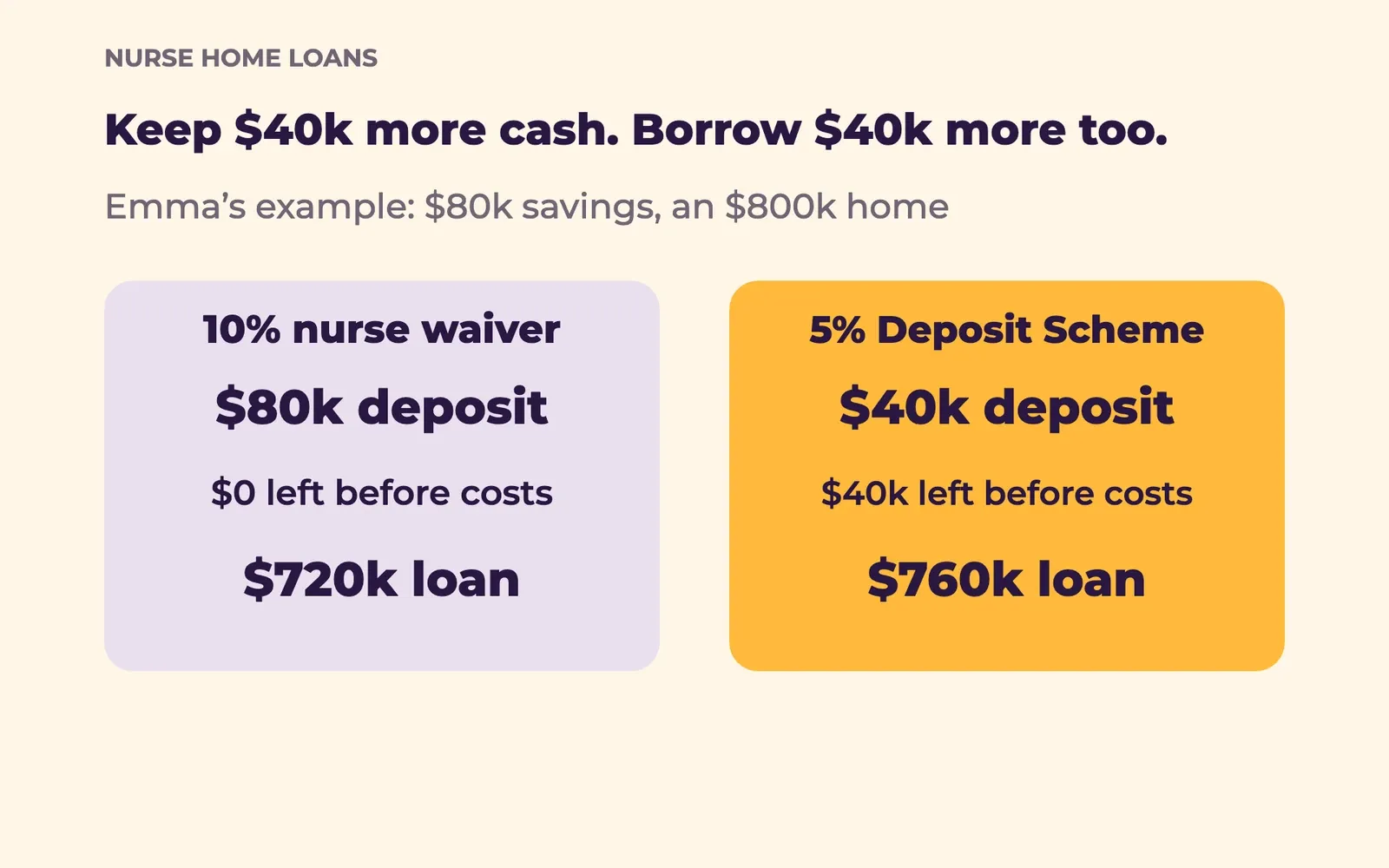
This example assumes the bank values the home at the $800k purchase price. A lower valuation could mean you need more cash. A Scheme lender may also ask for more than the minimum 5% deposit.
I'd allow separately for duty, registration, legal fees and inspections. Our buying costs guide helps you work through those bills before deciding how much of your savings to use.
How much LMI could a nurse waiver save on a $1m home?
On a separate $1m purchase, a 10% deposit is $100k and the loan starts at $900k. A standard loan could add about $24k in LMI. An eligible nurse waiver removes that premium.
- About $24k LMI
Standard loan with LMI
$124k upfront: $100k deposit + about $24k LMI. Buying costs are extra.
- Save about $24k
With an eligible LMI waiver
$100k upfront for your deposit. Buying costs are extra.
These figures use an assumed $24k premium paid upfront. Your lender's actual premium can differ from this example and our calculator estimate. If the lender lets you add it to the loan, you'd owe about $924k and pay interest on the premium too. Buying costs are extra.
If a waiver doesn't fit, compare the LMI quotes too
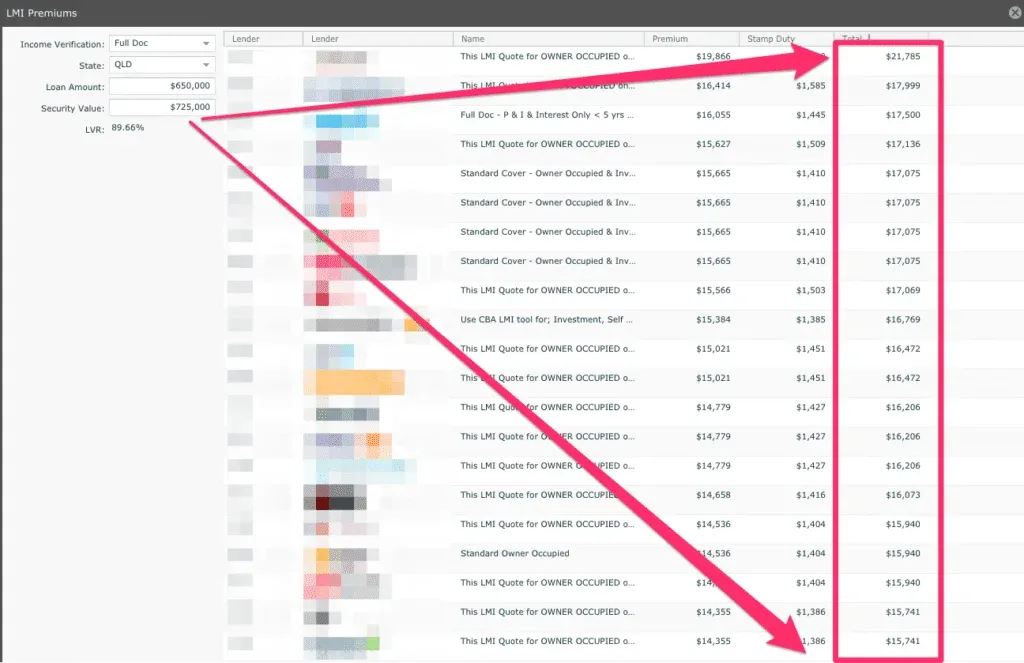
If a waiver doesn't fit, I'd still compare the LMI quotes. The earlier comparison below used a $650k loan on a $725k property. Total premiums, including duty, ranged from $15,741 to $21,785: a $6,044 difference for the same loan and property figures.
Those are historical figures, not a quote for your application. They show why I'd compare the premium alongside the interest, fees and features rather than assume every standard loan costs the same.
Which nurses may qualify?
I'd start with your Ahpra registration and the role on your payslip. You might be a clinical nurse, educator or nurse manager, but it's your underlying registration that helps determine which professional waiver is available.
Working outside a public hospital doesn't automatically rule you out. Tell me if you're in a private hospital, aged care, community nursing or an agency so I can compare the right employment requirements.
What if your job title is different?
| Your registration or role | Where I would start |
|---|---|
| Registered nurse | Nurse waivers, subject to the lender's income and employment rules. |
| Enrolled nurse | General no LMI loans, the 5% Deposit Scheme and standard loans. EN registration is different from RN registration. |
| Specialist or senior nursing title | Your underlying registration, rather than the job title alone. |
| Nurse practitioner | Your RN registration and nurse practitioner endorsement, together with your income and employment. |
| Assistant in nursing (AIN) | General no LMI loans, the 5% Deposit Scheme and standard loans. An AIN role alone doesn't meet the RN requirement. |
| Midwife or dual registration | Westpac and St George include midwives. People First requires RN registration; midwifery registration alone is not enough. |
Where your nursing registration fits
Registered nurse
- Where I would start
- Nurse waivers, subject to the lender's income and employment rules.
Enrolled nurse
- Where I would start
- General no LMI loans, the 5% Deposit Scheme and standard loans. EN registration is different from RN registration.
Specialist or senior nursing title
- Where I would start
- Your underlying registration, rather than the job title alone.
Nurse practitioner
- Where I would start
- Your RN registration and nurse practitioner endorsement, together with your income and employment.
Assistant in nursing (AIN)
- Where I would start
- General no LMI loans, the 5% Deposit Scheme and standard loans. An AIN role alone doesn't meet the RN requirement.
Midwife or dual registration
- Where I would start
- Westpac and St George include midwives. People First requires RN registration; midwifery registration alone is not enough.
If you're registered as a midwife only, our home loans for midwives guide covers the lenders and income rules that apply to you.
You can look up your registration on the Ahpra register. I'd then check the income minimum and employment rules in the lender comparison. Your deposit, debts, credit history and the property still need to fit.
How much of your shift pay will count?
If overtime and shift penalties make up a fair chunk of your pay, I'd want to look at those before comparing lenders. They don't all count that income the same way, and that can change how much you can borrow. Your base salary alone may leave out an important part of what you earn.
I'd check which payments People First will count towards the waiver's income minimum. That's separate from how much of your overtime and allowances it uses to work out the loan amount.
Westpac and St George can count 100% of eligible overtime and allowances for qualifying nurses, including hospital employed nurses. I'd check the type of pay and your income history before relying on that full amount. Self employed applicants have different income requirements.
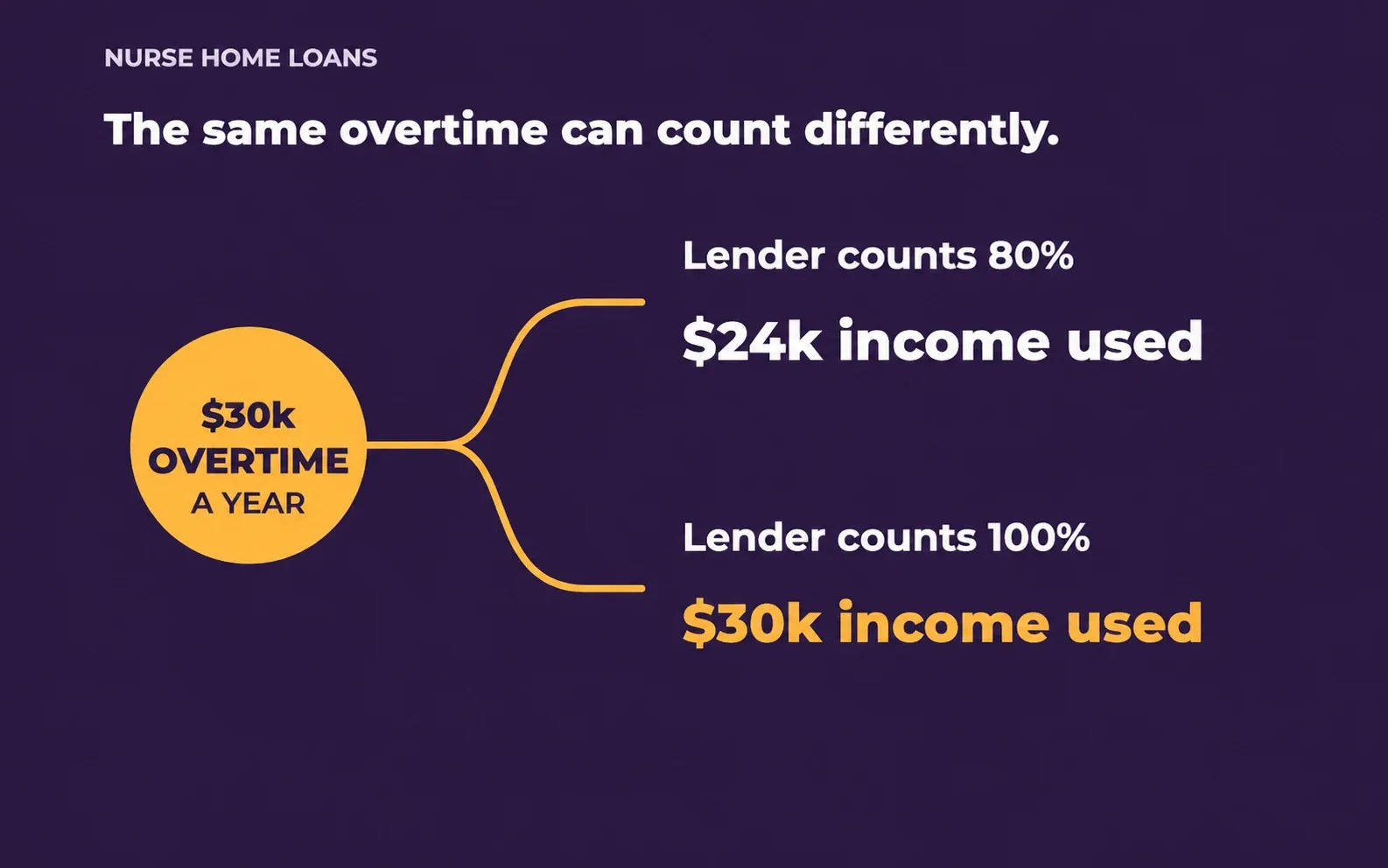
On $30k of regular annual overtime, accepting 100% instead of 80% means the lender uses another $6k of income. It doesn't mean you can borrow only $6k more. I'd work through your debts, expenses and repayments to see what difference it makes to your borrowing amount.
| Pay or situation | What I would look at | Useful evidence |
|---|---|---|
| Overtime and shift penalties | How much is regular and how much the lender will accept. | Payslips, year-to-date totals and income history. |
| Meal and other allowances | Whether the payment is income or reimburses a work expense. | An allowance breakdown and payment frequency. |
| Salary packaging | Meal and living expense benefits, so they are not missed or counted twice. | Payslips and your employer or packaging provider breakdown. |
| 2 hospitals or employers | How long you have held each job, your hours and whether you can maintain both. | Payslips and employment history for each job. |
| Casual or agency work | Your earnings over time. Some professional waivers exclude casual work. | Work history, payslips and annual income records. |
| Parental leave or probation | Your income during leave, return plans and any probation restrictions. | Employer letter, leave income and return to work details. |
How I would work through your nursing income
Overtime and shift penalties
- What I would look at
- How much is regular and how much the lender will accept.
- Useful evidence
- Payslips, year-to-date totals and income history.
Meal and other allowances
- What I would look at
- Whether the payment is income or reimburses a work expense.
- Useful evidence
- An allowance breakdown and payment frequency.
Salary packaging
- What I would look at
- Meal and living expense benefits, so they are not missed or counted twice.
- Useful evidence
- Payslips and your employer or packaging provider breakdown.
2 hospitals or employers
- What I would look at
- How long you have held each job, your hours and whether you can maintain both.
- Useful evidence
- Payslips and employment history for each job.
Casual or agency work
- What I would look at
- Your earnings over time. Some professional waivers exclude casual work.
- Useful evidence
- Work history, payslips and annual income records.
Parental leave or probation
- What I would look at
- Your income during leave, return plans and any probation restrictions.
- Useful evidence
- Employer letter, leave income and return to work details.
If your work has changed, our casual employment and new job loan guides explain the evidence that can help. Our HECS guide covers how student loan repayments can affect the amount you can borrow.
Planning leave? Our parental leave home loan guide explains the return to work evidence to prepare.
Let's work out how much of your shift pay counts
Compare nurse waivers and other home loans
Saving LMI is a good starting point. I'd also want to know what the loan costs each month and how much cash you'll have left after buying. If another option charges LMI but works out cheaper overall, I'd put that alongside the waiver so you can compare the two.
| Option | Deposit and income starting point | Main restriction |
|---|---|---|
| Westpac | About 10% deposit; registered nurse or midwife earning at least $90k a year. | Registration, income history, employment and loan purpose must fit. |
| St George | About 10% deposit; registered nurse or midwife earning at least $90k a year. | Self employed nurses need acceptable business income records; see the lender details below. |
| People First Bank | About 10% deposit; RN. $80k single, or $150k joint with at least $75k from the eligible worker, excluding super. | Up to $1.2m; permanent or fixed term, full time or part time. No casual work or probation. Principal and interest repayments. |
| ubank | About 10% deposit for eligible purchases. No professional registration or professional income threshold. | Principal and interest. Above 85% of the accepted property value, the limit is $2m per application. |
| 5% Deposit Scheme | Minimum 5% deposit. No income cap. | Buyer rules, local price cap, living in the home and participating lender approval. |
| Standard loan with LMI | A smaller deposit may be possible. | Compare the quoted premium, interest and fees with the no LMI options. |
Deposit, income and restrictions to compare
- Deposit and income starting point
- About 10% deposit; registered nurse or midwife earning at least $90k a year.
- Main restriction
- Registration, income history, employment and loan purpose must fit.
- Deposit and income starting point
- About 10% deposit; registered nurse or midwife earning at least $90k a year.
- Main restriction
- Self employed nurses need acceptable business income records; see the lender details below.
- Deposit and income starting point
- About 10% deposit; RN. $80k single, or $150k joint with at least $75k from the eligible worker, excluding super.
- Main restriction
- Up to $1.2m; permanent or fixed term, full time or part time. No casual work or probation. Principal and interest repayments.
- Deposit and income starting point
- About 10% deposit for eligible purchases. No professional registration or professional income threshold.
- Main restriction
- Principal and interest. Above 85% of the accepted property value, the limit is $2m per application.
- Deposit and income starting point
- Minimum 5% deposit. No income cap.
- Main restriction
- Buyer rules, local price cap, living in the home and participating lender approval.
Standard loan with LMI
- Deposit and income starting point
- A smaller deposit may be possible.
- Main restriction
- Compare the quoted premium, interest and fees with the no LMI options.
The sources below include public lender offers and People First's lending conditions dated 8 September 2026. Buying costs are extra for every option.
What I would check with each lender
What could change your options?
The valuation is lower than the price
At a 90% loan limit, an $800k purchase valued at $780k supports a $702k loan. You need $98k towards the price, plus buying costs.
Your roster or employer changes
Tell me about a new job, probation, reduced shifts or planned leave before we choose a lender. I want the application to reflect the income you expect to keep earning.
The waiver leaves too little cash
I'd set aside duty, legal costs and inspections before deciding how much of your savings to use. You also need money left after moving in.
The cheaper loan charges LMI
I'd compare interest, fees and flexibility over the time you expect to keep the loan. Avoiding the LMI premium is one part of that decision.
If you are comparing a loan without an LMI waiver or government scheme, our LMI calculator estimates the cost using your purchase price and deposit. The lender or insurer confirms the final premium.
Other help with a smaller deposit
If you have less than 10% saved, I'd look at whether the Australian Government 5% Deposit Scheme could help. It has no income cap, but you still need to meet the buyer rules, stay within your area's price cap and get approval from a participating lender.
For an existing home, you need to move in within 6 months of settlement. Hannah's story shows why I'd ask about the lease before you commit to a tenanted property.
If you're buying an investment, I'd compare People First's public offer and ubank's general no LMI option, then confirm the investment rules for any other nurse waiver. The Government Scheme is for a home you will live in.
Could family equity help?
A family member may be able to use equity in their property to help you buy with less cash and reduce or avoid LMI. I'd talk through the risk with you both: their property is at risk if you can't repay, and they need independent legal advice. You still need enough income to afford the loan. Our guarantor guide explains how it works.
Check grants and duty concessions separately
I'd check grants and stamp duty concessions separately from the loan. What you can claim depends on where you buy, the property and whether you've owned a home before. Our first home buyer grants guide explains the options.
Before counting a grant or concession in your budget, check the current conditions with Queensland Revenue Office, Revenue NSW, State Revenue Office Victoria or the authority where you're buying.
What to prepare before applying
- Your current Ahpra registration.
- 2 recent payslips and your latest income statement. We may need a longer pay history for overtime or casual work.
- A breakdown of overtime, shift penalties, meal allowances and salary packaging.
- Payslips and employment history for each hospital, agency or second job.
- An employer letter if you're on probation, have changed jobs or are planning to return from parental leave.
We'll also need your ID, savings and debt details. I'd use those with your pay records to compare the borrowing amount and cash needed for each option. Our pre-approval guide explains what the lender still needs to check before you buy.
What happens after you send your payslips?
- First, I'd compare your registration, pay, debts, deposit and buying costs with the loans available to you.
- Once you choose an option, our team prepares the application. The lender assesses it, and we explain any pre-approval conditions before you rely on the price range.
- When you find a property, send us the contract and tenancy details. The lender checks the property and valuation; your solicitor handles the contract and legal checks.
- We work through outstanding lender requirements and confirm final approval before you rely on finance being ready.
- For settlement, you'll complete the loan documents, arrange required insurance and have your contribution ready. The lender and your solicitor coordinate settlement.
Nurse home loan FAQs

Experience and sources
How this guide was checked
I've used the sources below to compare who qualifies, how lenders treat nursing income and what each option could mean for your deposit. People First's detailed income and employment rules were checked against its lending conditions dated 8 September 2026.

Jayden has worked in finance since 2006 and joined Hunter Galloway in 2018 after working in private and commercial banking. He holds a Bachelor of Business and a Certificate IV in Finance & Mortgage Broking.
Sources
- Westpac nurse and midwife home loans
- St George professional home loans
- People First Bank Essential Services Package
- ubank no-LMI home loans
- Australian Government 5% Deposit Scheme
- Ahpra register of practitioners
- Nursing and Midwifery Board of Australia
- Moneysmart LMI guide
- People First Bank Essential Services Professionals lending conditions, 8 September 2026
- ubank purchase loan-size limits
- Nursing and Midwifery Board: nurse-practitioner endorsements
- People First Bank investment loan rate card
Policy detail is based on checks dated 8 September 2026. Lender requirements and fees can change. Client names and identifying details have been changed for privacy. I'll review your circumstances before recommending a loan.
How are we paid?
The lender pays us commission, which we disclose before you proceed. Hunter Galloway is independently owned, compares more than 30 lenders and must put your interests first. We explain relevant alternatives when a nurse waiver is not the best fit.
Read how we review lenders for our approach to the comparisons.